Odyssey Works · lived research
The project as submitted
This page is frozen. It reproduces the research as delivered to the Odyssey Works Experience Design Certificate Program in summer 2026, including its numbers. The census has grown since; where this page and the archive disagree, this page is the record of what was true on the day it was submitted.
1 · The Questions
I set out to study what voice does when the body disappears: not as deprivation, but as a set of design conditions — the narrowed sensory channel that concentrates attention, the imaginative gap a listener fills with a speaker optimized for themselves, the disclosure that emerges when two people cannot see each other. The guiding question was what voice does to trust, intimacy and consent that no other medium replicates, and whether that has a design grammar precise enough to use deliberately.
Three questions emerged that I did not bring with me. What does informed consent mean when the participant will not retain the experience? Who holds the memory of a one-on-one work when the person it was made for cannot reach it? And what distinguishes a silence that has been marked from one that has not? The first of these has become the center of the research.
How we live is how we learn
2 · The research
I interviewed thirteen practitioners across telephonic theater, interactive audio drama, crisis negotiation, improvised telephonic comedy and autoteatro — among them Yannick Trapman-O’Brien, Evan Neiden, Megan Markham, Stepy Kamei, Parker Sela, Allen Otto, Griffin McInnes, Ant Hampton, Ezra Reaves and Nicky Perfect, formerly the United Kingdom’s Director of Hostage Negotiation. Their common ground is that they build trust with a stranger through voice alone, at speed, with something at stake. I cataloged sixty-five works of telephonic performance staged between 2020 and 2026, effectively the whole visible field, and called into twenty-four of them. I built and ran a prototype in which participants speak with an artificial intelligence trained on a clone of my voice and learn what it was only at the end.
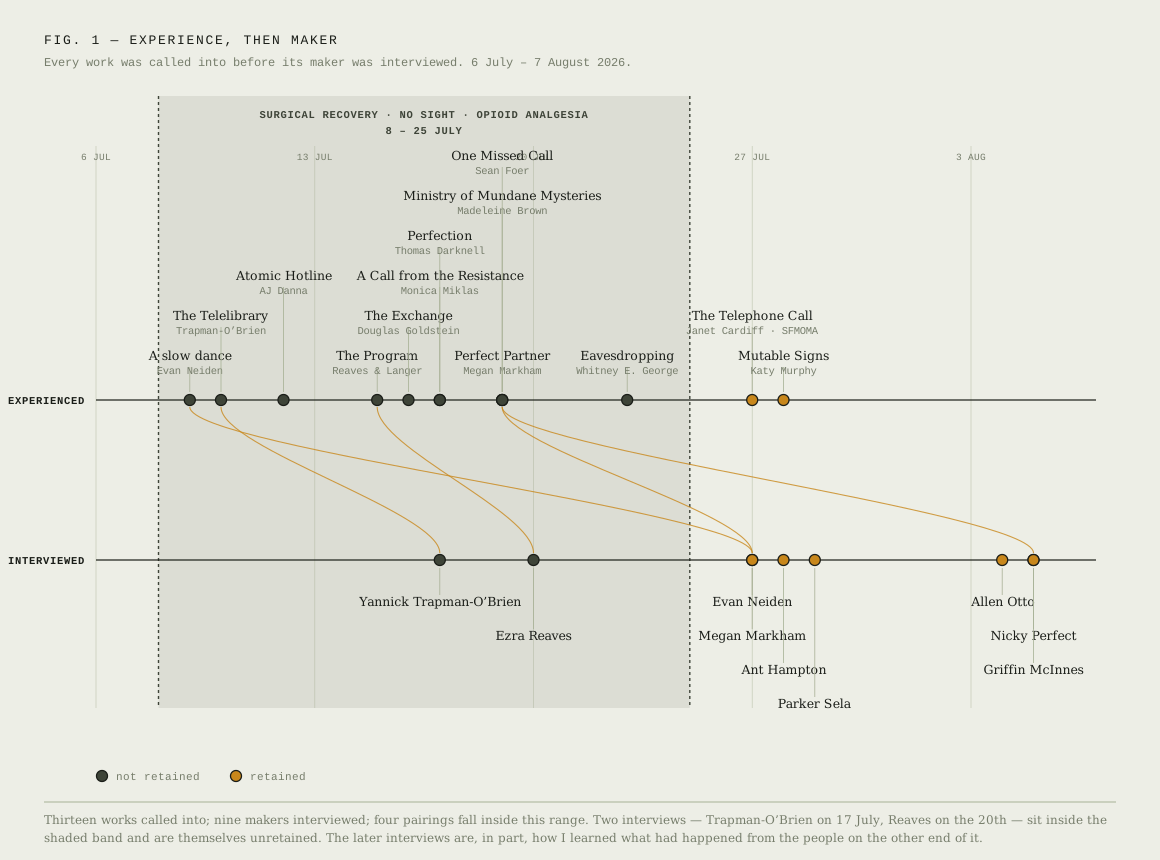
A fourth condition arrived that I had planned for only in part. Between 8 and 25 July I was recovering from surgery: without sight for the first two weeks, on opioid analgesia, and in pain. My advisor had identified the loss of vision in advance as the research’s most embodied phase, and it was. What none of us anticipated was that the medication would prevent me forming durable memory. I conducted two interviews inside that window and took part in seven phone experiences. I hold the recordings, the file metadata, the correspondence and a printed program carrying a contribution under my own name. I have no retained experience of any of it.
I have treated this not as an interruption but as the condition the research was pointing at. My proposal committed to being the instrument of the study; the instrument recorded and did not retain. Each practitioner was told at the outset that the finished document would come back to them to check for error, so every attribution here is provisional until they have seen it.
Two things from that period are missing in opposite directions, and both are documented in full under Two Losses. In the first days after surgery I interviewed a practitioner in commercial phone-based intimate labor — the population my proposal named as the field’s most conspicuous absence. No recording survives, yet I retained its substance: the sadness of being assigned a role and hung up on the moment a caller had what they wanted; the other calls where people rang to talk about ordinary things and he felt he played no role at all; and his conviction that he was authentic while staying necessarily guarded about his identity, his partner’s and his family. He did not find those two things contradictory.
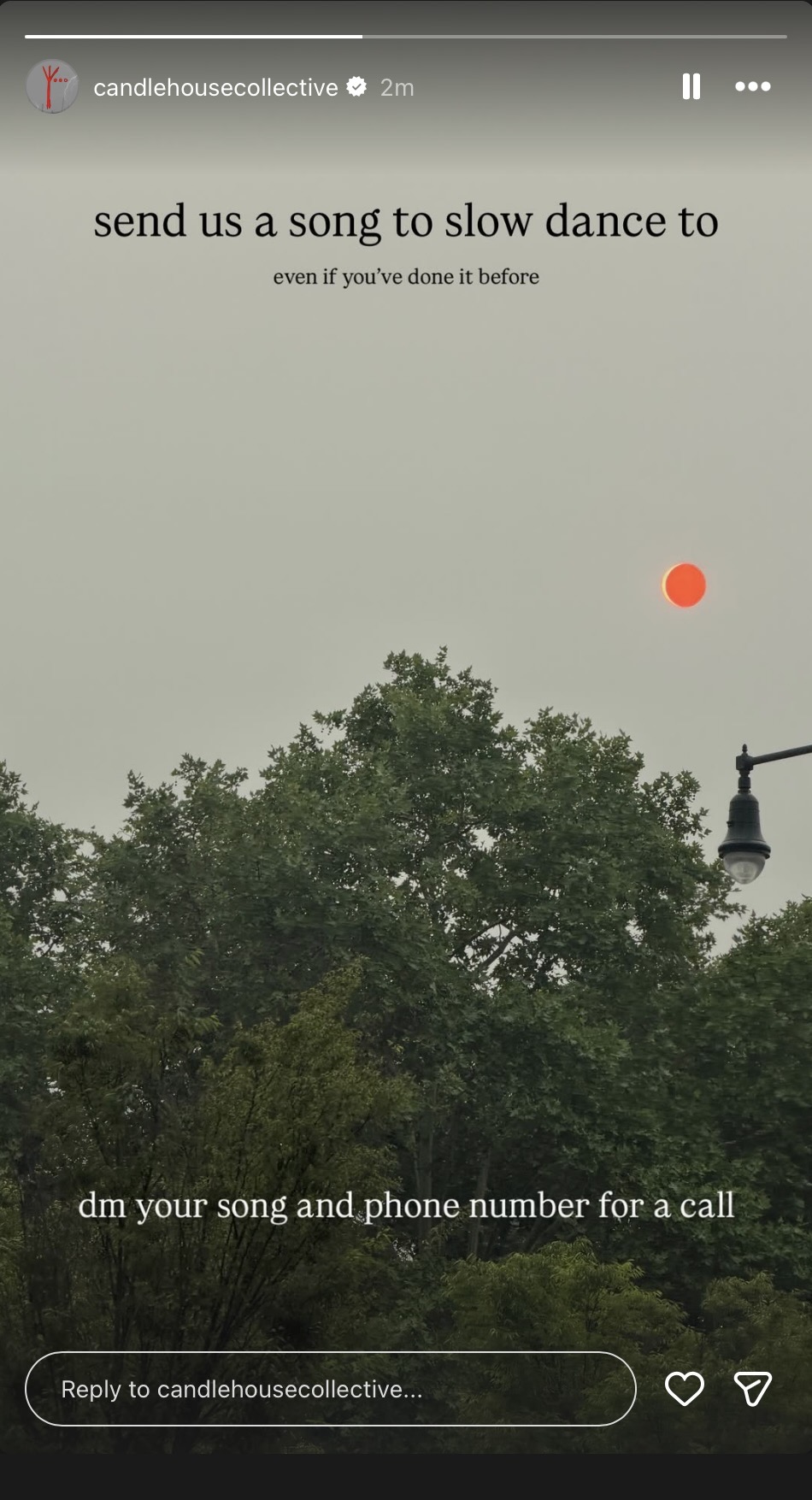
The second loss produced a finding I could not have designed. Candle House occasionally offers followers an unscheduled piece called a slow dance as part of its occasional “musing” offering: you send a song, and the operator calls to improvise a poem from it. I had hoped for this immersive experience since I’d first learned of it.
Interviewing the company’s artistic director some weeks after surgery, I mentioned hoping one day to receive one, and learned that I already had. The wanting was intact and had never stopped. The having left me with nothing but loss.
3 · What I learned
Eight findings are set out in full, with sources, below. Four matter most here; a fifth appears under Application, because it is the one that reshaped the work.
The first is that a widely shared intuition about phone silence is wrong in a useful way. Trapman-O’Brien and Markham independently named roughly six seconds as the longest silence a caller will tolerate, because they cannot see a face to know they are still held. Nicky Perfect routinely holds far longer — she announces the silence first, tells the person she is there and to take the time they need, then counts to ten. Nothing ruptures. The ceiling is not on silence but on silence the listener cannot account for, and a spoken declaration does the work the face would have done. That is a designable move, not a talent.
The second is that consent behaves differently for the two parties. For the designer it is an event: asked, answered, logged, durable. For the participant it is a state that must be continuously held, and states perish. Markham must offer three to five refusals before anyone takes one, because compliance is the default; Allen Otto warns from the other side that repeated permission can function as cover, accumulating a record of agreement that licenses what it was meant to guard against. Which one obtains depends entirely on whether the participant retains the asking. The field has been building on the event and assuming the state.
The third is that when encoding fails, the archive becomes the memory. My timeline was rebuilt from file timestamps rather than recall — an extreme instance of an ordinary condition, since the participant in any one-on-one work leaves holding an impression while the company keeps the record. The asymmetry I had been designing into a fiction is the medium’s default state.
The fourth answers the second. Perspicuum Immersive requires a form before Perfection, asking about your worst insecurities and proudest moments, and uses what you write to personalize the call — then tells you that you can avoid some of its triggers by leaving things off the form. The participant defines in writing, in advance, what the piece may know and therefore what it can do to them. Because that boundary is structural, it keeps protecting someone who retains nothing during the call. It is the only consent architecture I found that survives the condition I was in.
4 · Application
I arrived with a different fall project — a phone booth built on a chain of participants observing one another — and the research retired it before I built it. The forward pass is not new: the Telelibrary, Katy Murphy and Ant Hampton all run versions of it. The only thing distinguishing mine was that the person described had agreed to nothing, which Sumner names as a liability rather than a contribution.
What replaces it is 1337 — hacker orthography for elite. A recreated 1995 bedroom with a telephone and the number for the DEFCON voice bridge.
Phreaks teach the participant to social-engineer a corporate PBX while call waiting delivers the life that competence is an escape from. One line, two calls, only one at a time. The participant wins — unlimited free long distance anywhere on earth — and then the bridge empties out, because it is a school night. The last thing they do with the stolen line is initiate the next participant.
The pass survives; the problem does not. What travels is how someone played, not a private fact about a stranger who never agreed. The other findings land specifically: silences on the bridge are announced before they are held; hanging up is period-perfect, free, and taught in the first five minutes; content is disclosed by name before booking. Kamei’s Dr. Carlson, an offboarding character written into the fiction of One Bad Day, is the model for the debrief; Darknell’s form is the model for the consent. And the ending is the fifth finding, which I did not choose and could not have designed: anticipation, experience and retention came apart in me, and the desire outlasted both the event and any memory of it. So in 1337 you get the mastery you wanted, in full, and it arrives with nothing left to spend it on.
One thing I do not have. 1337 puts my father’s incarceration into a piece a stranger performs. Kamei, developing a work about a woman killed by her stalker, was told by that woman’s mother that she was the guardian of her daughter’s memory, and given explicit permission. I have no equivalent, and will not build the home calls until I understand more about what the portrayal of a real person requires.
Advisors: Abraham Burickson and Krishnan Unnikrishnan.